
Spacetime Travel in Namibia: Why Empty Places Are Never Empty
Did we get swallowed by a wormhole? (Chapter 6)

Once our tires left the asphalt and hit the gravel I slid down into a gentle panic. Moving on this new type of road, into this new reality, was so incredibly loud! As our wheels turned at about 50 km/h, almost every second we heard pieces of rock mercilessly hitting the bottom of our Ford Ranger. Some of the ‘clinks’ sounded higher pitched, indicating a smaller rock contacting the metal. Other noises sounded more like a ‘BANGGG’. Those were the ones that made my heart rate jump up, because it was clear that a larger rock hit our vehicle. Small or large rocks, hearing the ongoing spray of debris against our car provided an unsettling introduction to our first gravel road in Namibia—or the ‘orange line’ on the paper road map on my lap. And it instantly set off alarm bells in my brain about our oh so expensive car insurance.
“Is this normal?” I asked Ali, as if he knew the answer. He was the one behind the wheel. “Can this car handle all this beating?” I repeated with more urgency.
Welcome to Journey through Sand & Space, an ongoing series covering the full story of our epic road trip in Africa’s most spacious nation: Namibia. I’m releasing a new chapter each second week(-ish), and you can watch our accompanying YouTube video series documenting the journey. Subscribe to The Rola Coaster to get the next chapter.
Ali was shocked by the level of noise as well. But after a few minutes of listening to this painful symphony, we submitted to a new truth that we quietly urged ourselves to believe: this car must be made for this kind of road. Because if it can’t handle the extra suffering added by driving gravel, they would have never given it to us for this trip, right? In the next days, confidence in and respect for our car would grow to proportions I could have never imagined. But right now, in the first hour of our journey south, what I didn’t feel so confident about was us driving the thing.
Namibian gravel roads are not just painted by different sized rocks. The rocks, from tiny to boulder-like, tend to congregate in different areas of the road. This makes for piles of debris one must avoid in the very last second, we soon learned. Add to this the fact that the road is also going up and down. Occasionally, it drops so far down, that Ali was forced to abruptly hit the brakes, to stop our suspension from maxing out, or stop a nosedive into the next hill. So naturally, it did not take more than a couple of kilometers in this unpredictability to understand why our rental agency begged us to stick to 80 kilometers per hour. For some reason, it was easy to get up there, to 80. But it was equally easy to be fooled by the expectation of an easy road and having to do a surprised tug at the wheel to adjust for a huge stone in our path. The scary thing was that Ali’s response time was not up to date yet, it was still lingering somewhere on the German autobahn. Here, on these roads, I immediately felt the danger of being inattentive. Unlike the secure grip of asphalt, this felt slippery as hell. But we slithered on. And after about 1 hour of driving, it was my turn to give it a try.
Learning to Drive in Emptiness
Ali slowly decelerated and prepared to stop the car. The tires made a kkgrrrrrh sound on the gravel until we stood still. We didn’t bother to park the car on the side of the road. First, because we would probably get stuck in the bush, and second, because we were not in the way for anyone or anything. There was no one else around. We both opened our doors and an oppressive, dry heat hit our faces. With the AC on, we almost forgot we were in sub-Saharan Africa. I let my feet hit the ground and got out of the car with the intention to stretch my legs and take in the surroundings. Besides a constant high pitch of cicadas there was nothing else to hear. A golden vista of dry savannah spread out all around us. An arid wind caressed my face. Gravel crunched under my feet while I took a few steps. So this is what it feels like to be alone in a big land? It was a sensation both eerie and exciting at the same time. I got excited thinking about the rest of this day, and the trip, in a place completely new to me.
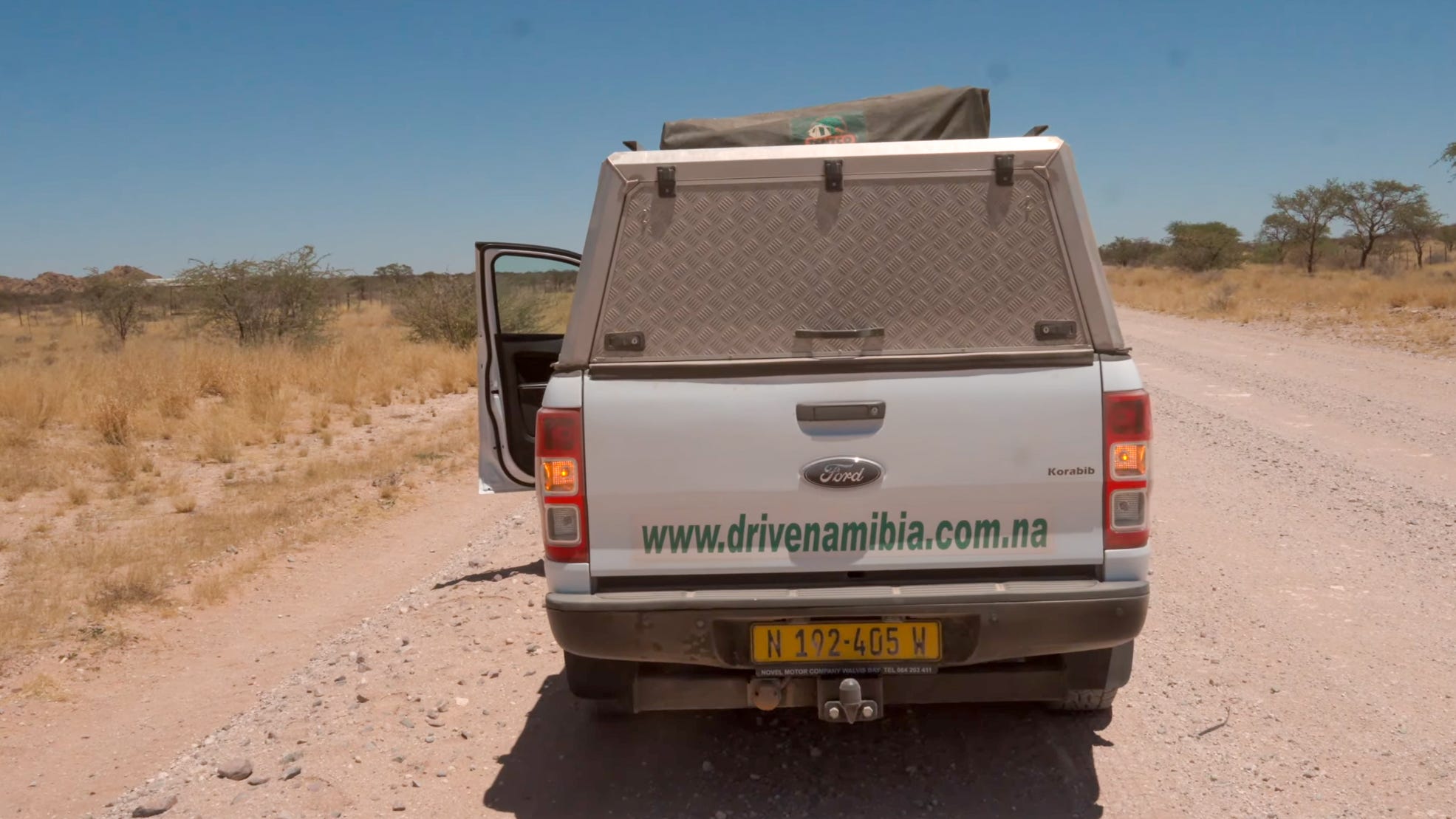
But as I was standing in the dry grass on the side of the road, my eyes caught the shimmering of a low, barbed wire fence that seemed to run all along the side of this gravel road. It was sort of hidden by the grasses that clutched around it, but it was there. Already since we left our first camp spot at Lake Oanob, I had noticed that while it felt like we were driving through endless fields of wild vastness, much of that vastness showed signs of being contained. Of being… owned. Was it possible that all this emptiness, no matter how much I wanted it not to be, was empty by design?
“Are you ready?” Ali had joined me on the left side of the car and jerked me out of my mental peace.
“No.” I replied.
We took some time to hydrate and take in the hugeness of silence. Then I walked over to the right, to the driver’s side of the car. I buckled into my throne, now my seat of power in our powerful truck, and started it up by… pushing the electric key in a hole. The beast started purring. I adjusted my sunglasses and lowered the hand brake. Hands a quarter to three, eyes on the road.
“Here we go!” I yelled. But… we didn’t move.
“Wait, is this the gas pedal??” I asked Ali in defeat. He laughed and then looked worried.
“Are you serious?” He said confused. “It’s that one!” He said bending forward and pointing down to the right side of my foot. “You only use your right foot, and that’s it. Don’t accidentally try to change gears with your left. That will make us brake really hard.”
“Ok sure...” I mumbled. I’d only have to ignore my core instincts built through 33 years of driving on the other side of the road. How hard could it be?
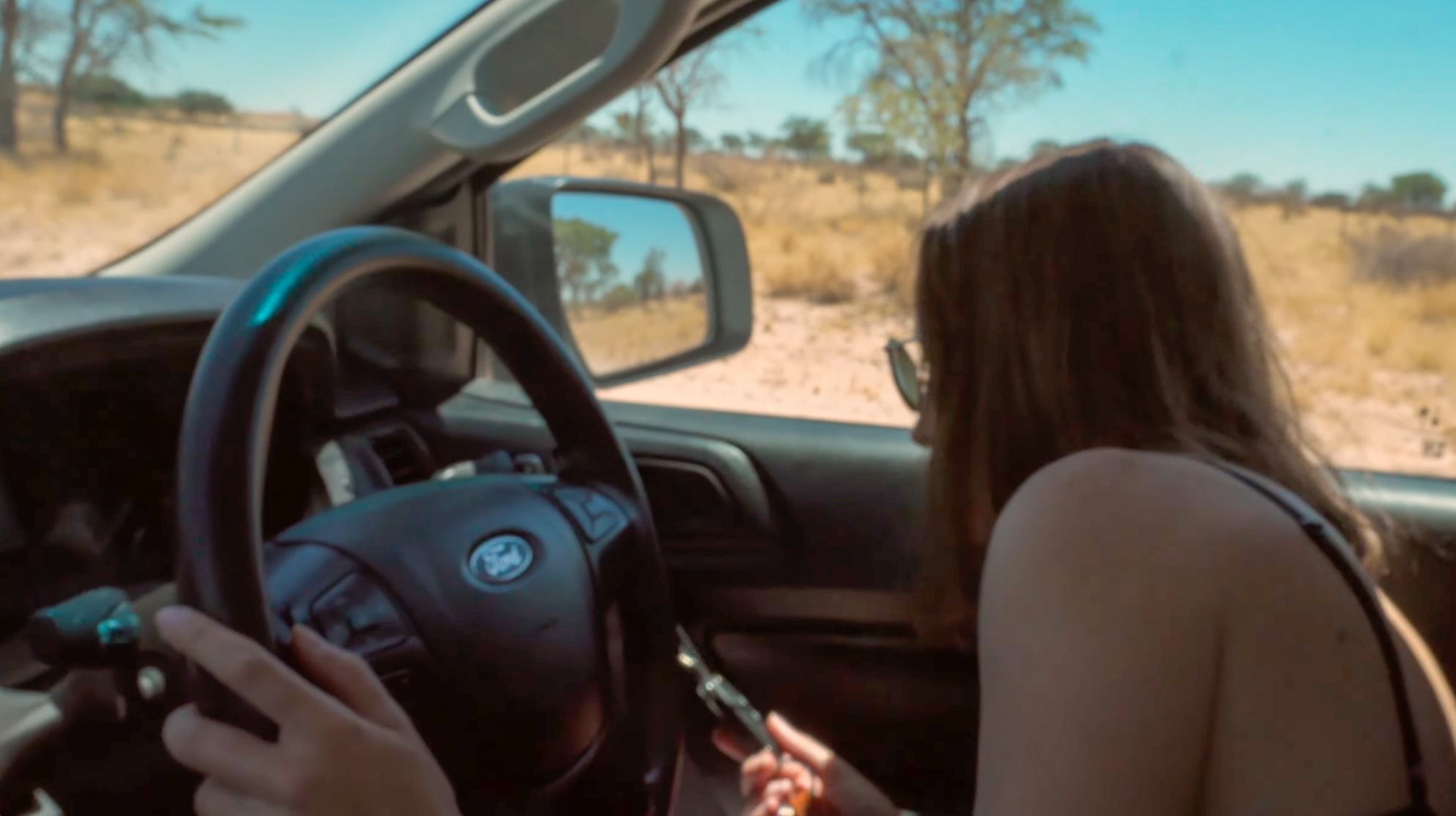
I gently pressed the pedal and the car rolled away with us. For the next 1,5 hours, I was very happy to see only two other cars coming towards us on the gravel road. Only two instances where I had to worry that I would accidentally drive into them. What a relief. In this way, the lonely roads of Namibia made it so much easier to ease into driving on the left side. Even though I’m used to driving on the left by scooter when we live our winters in Thailand. Doing it in a massive Ford Ranger over a slippery, sandy path equals totally different stakes, and a totally different vibe. And as it turned out, I liked that vibe.
Finally, I too could feel the road, and with that Namibia, in my hands. I didn’t just get used to the noise and the slippery feeling of driving on rocks. I enjoyed it a lot. I had 315 horsepower at my fingertips, speed at my toes, and the wide-open road to play around with. Through every winding curve, our beast roared, but I controlled her. This car was far more than just a vehicle; it was our guardian angel. Because inside of her, nothing could affect us. With her near 30-millimeter-thick tires, it could get us through anything in this deserted land. Unless one of those tires would burst.
That last thought sparked a little stress sensation in my chest. Here, over a hundred kilometers south of Windhoek, on a gravel road where seeing other passengers was a rarity, we were mostly on our own if it would come to car trouble. If a sharp rock would rupture a tire, we would have to change it ourselves, in the scorching sun. If the engine would fail, we would be stuck midday without AC on a path without shade. And, the worst possibility, if our vehicle would happen to break down on a stretch of gravel with no cell service, we would not be able to call for help—or look up on YouTube how to change that tire.
It appeared to me that we were completely unprepared to deal with the range of problems that could present themselves at any moment now. Did we just start a road trip in the emptiest country of Africa without fully understanding that the isolation that comes with that demands a level of skill and self-reliance that we don’t possess? In all the other trips that had come before, from cycling through Italy to backpacking Turkey, going in with zero prep and our usual happy-go-lucky outlook had always graced us. But here in Namibia, that attitude would not be so easily forgiven. I realized that while there are far more isolated places to travel through on this earth, this road trip was going to take me through some of the most remote areas that I had ever been in. Suddenly, I knew that all that space around us—away from people, from civilization, from support—comes at a cost. The feeling of freedom I felt just moments ago on the side of the road had shrunk into a tight ball in my stomach. And it was held together by something that was new to me: the fear of being alone.
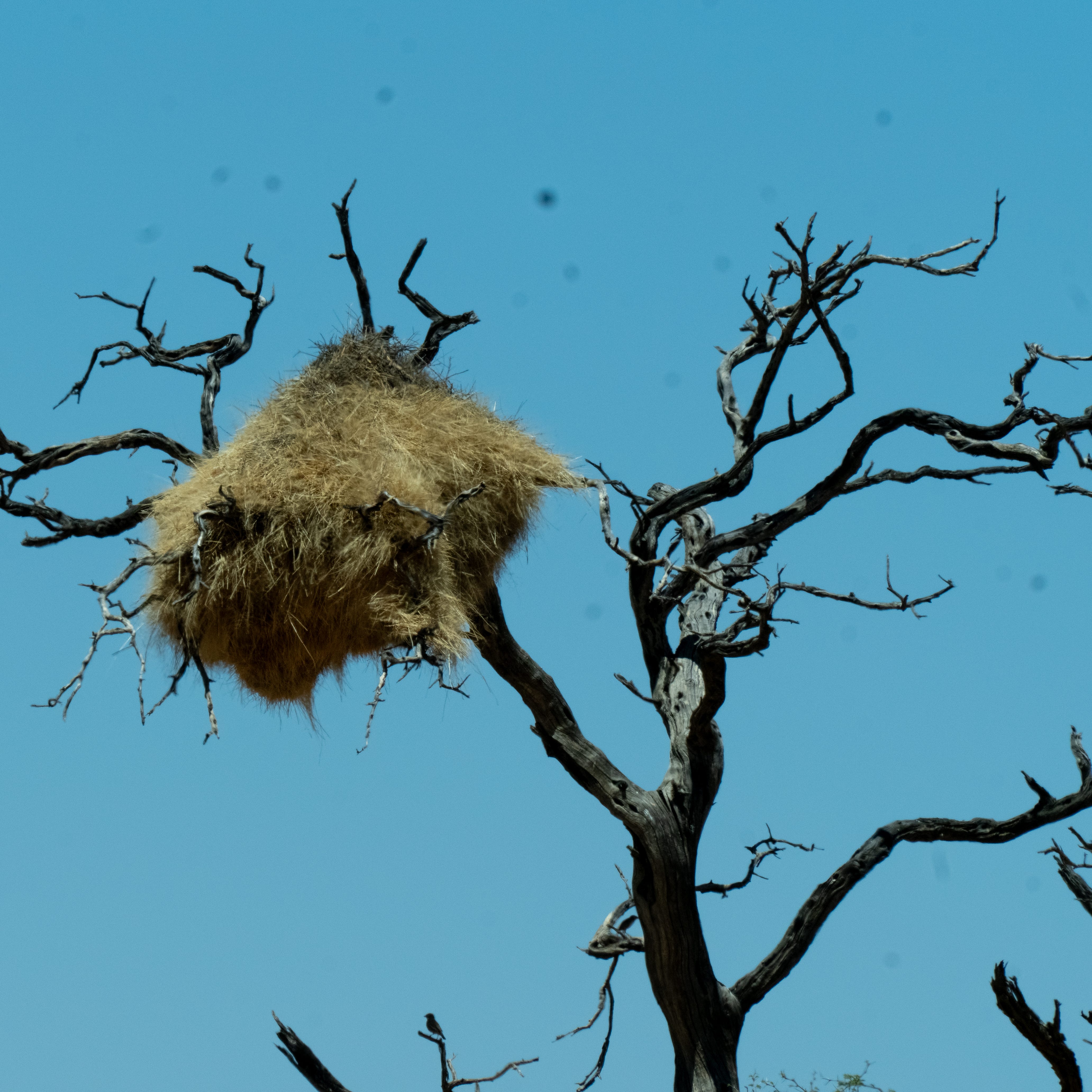
This fear would visit me more than once on this trip. But for now, as usual on my travels, I was one deep breath and one new experience away from being taken to a different corner of my mind. Now that we had gotten used to the fluidity of the road and eased into the movement of gravel, our horizon could expand. And what we saw around us kept on confirming itself: a simple continuation of a whole lot of space. In that kind of seemingly monotonous environment, it’s the interruptions that call your attention. One thing that broke this infinite landscape were interesting looking trees whose top parts seemed to be wrapped in layers of… hay? I stopped the car a couple of times to admire the little birds that fluttered in and out of these alien-looking draperies. We later learned that these big haystacks are communal nests of the sociable weaver bird, housing dozens to up to several hundred of its kind. Like an arboreal apartment complex, they live in the giant structure of coarse dry grass with openings to dozens of individual nest chambers in the bottom. As one would expect in a spacious nation, there is no other bird on Earth that builds a structure as large as these tiny weavers. And the architecture is surprisingly enduring. Living in a semi-desert is hard; these weavers usually only live a couple of years. But the striking thing is that their nests are permanent—continuously occupied for decades… and sometimes even centuries! So here we were, in a country that is as vast as it is old, looking at a tree where tiny brown birds that each live only a few years keep a home older than Namibian independence.
The Best Coffee
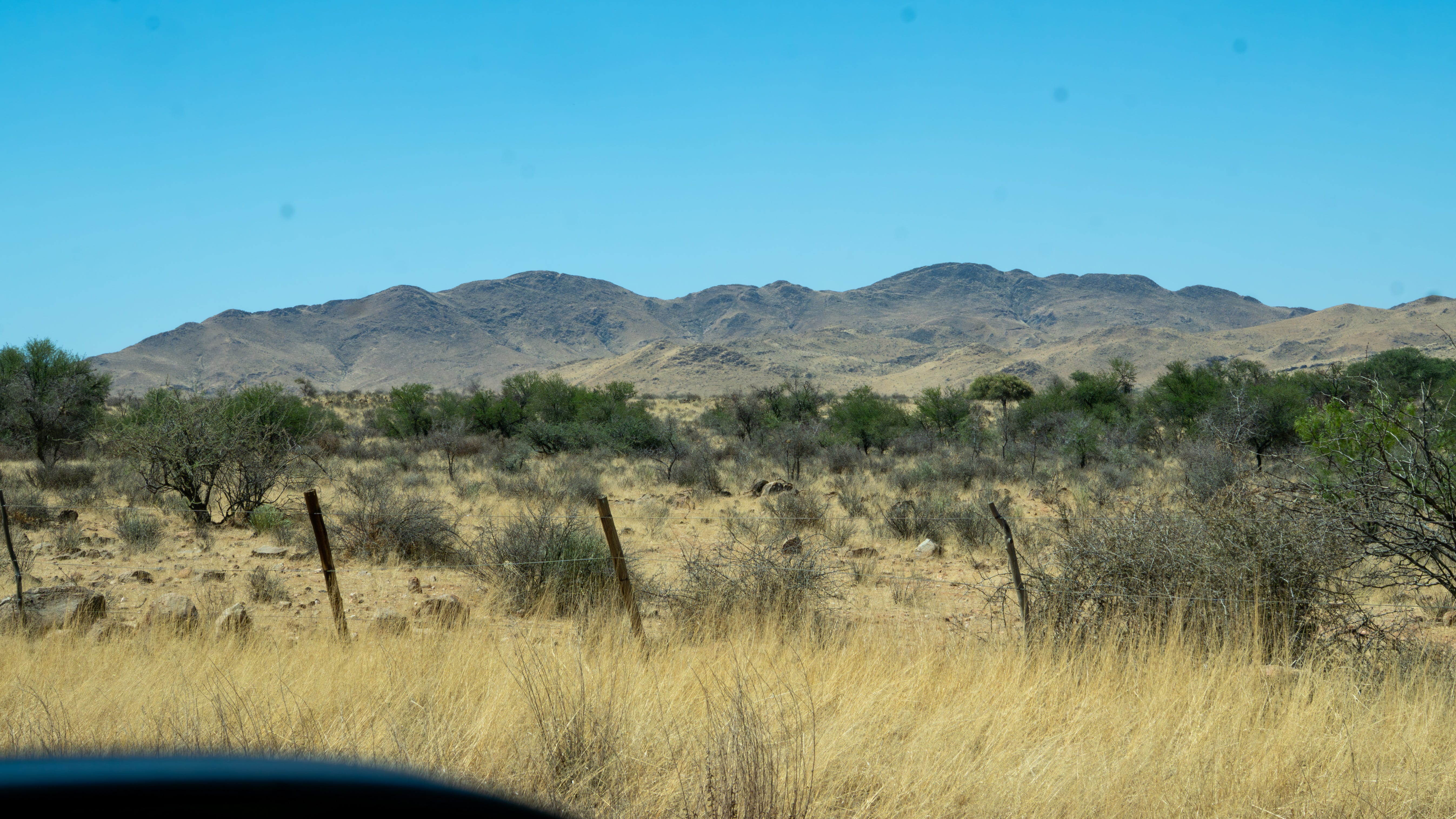
Left and right from our ongoing gravel path, yellow grass softly swayed in the wind up until the horizon. As we continued driving, it covered funny looking rock formations I detected in the distance. Until we were practically driving through golden hills. Just when we were discussing what we would do in case of a flat tire, a sign popped up in our view. It read: ‘Best Coffee’. Looks like we were not alone anymore, at least for now. And it looks like Namibians know how to reel in a couple of thirsty travelers.
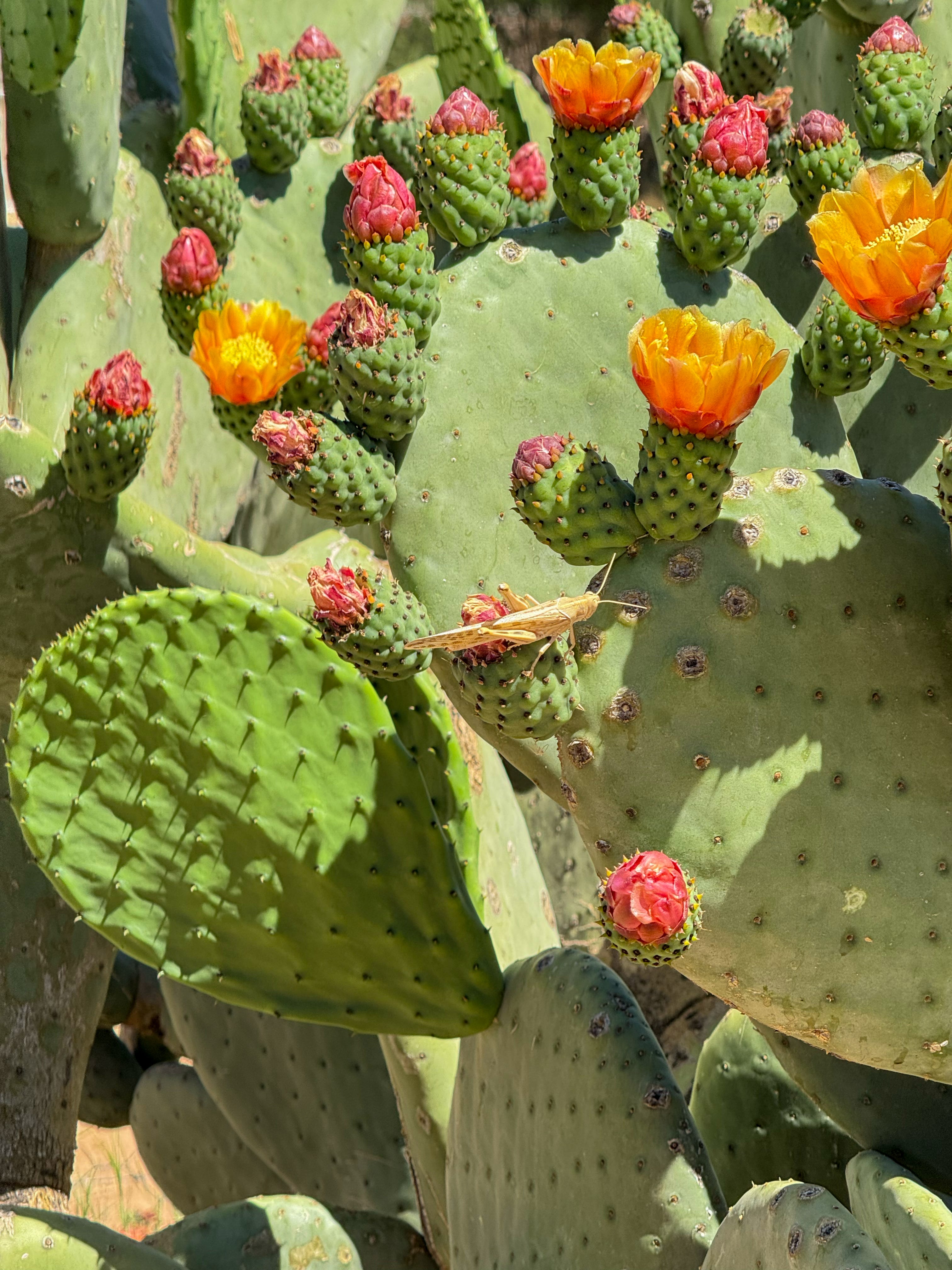
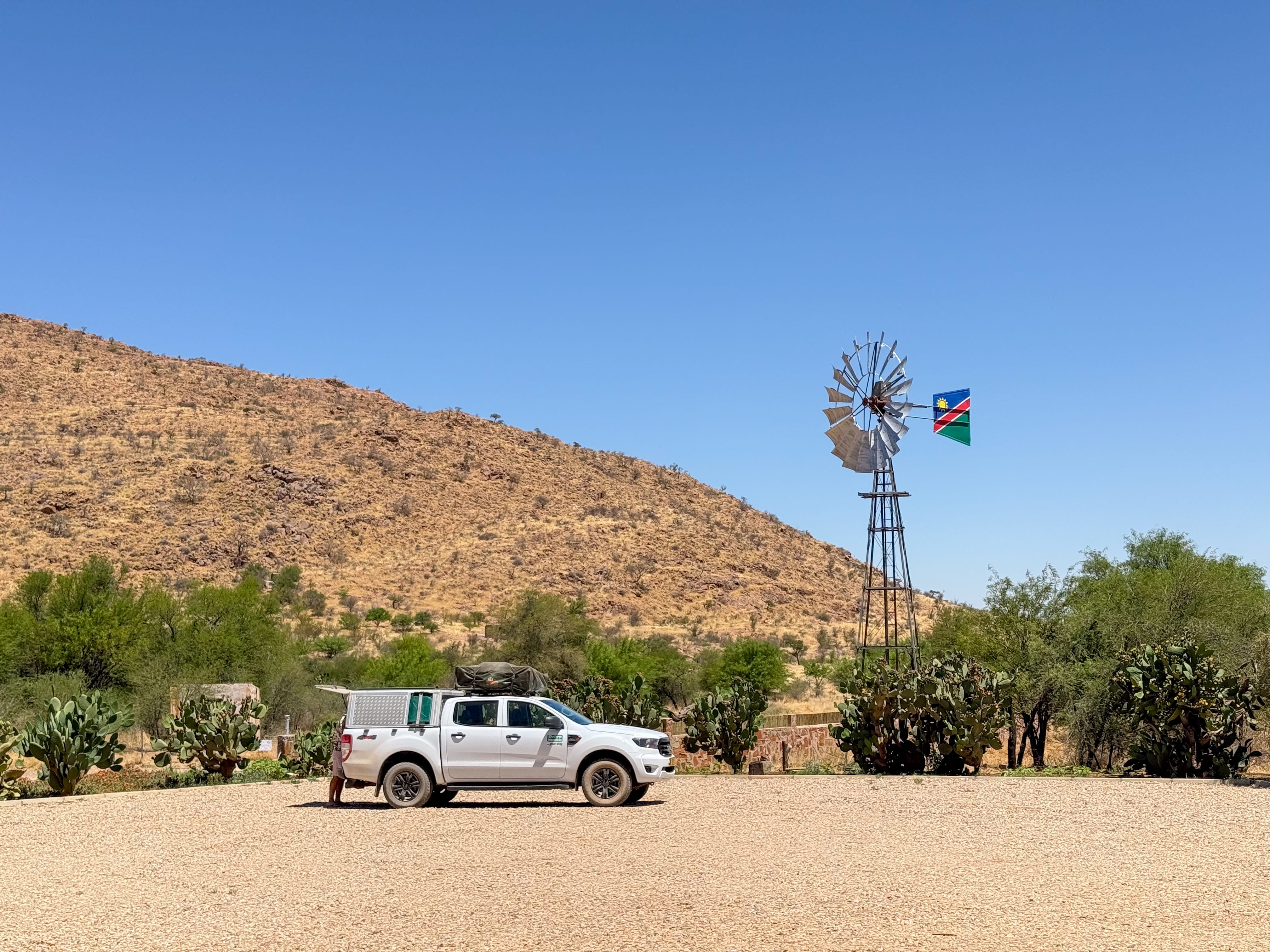
I had managed to drive us to our first rest stop. I slowed down our beast and guided her into a gravel parking lot that was surrounded by beautiful cacti plants, adding splashes of color on the otherwise beige canvas of rural Namibia. While I rummaged through our canopy looking for food and utensils, Ali walked over to the rectangular building to check out that coffee. Inside was a small souvenir shop that we explored a little, only to end up at the counter displaying the food and drink options.
As vegans travelling through one of the emptiest countries on earth, we had mentally and physically prepared ourselves for the worst. Here we were, in a country where biltong (a sort of beef jerky) and droëwors (dry sausage) are staples and Oryx or Kudu steak is a completely normal menu item. Luckily, after 2,5 years of traveling we had learned how to survive as plant-eaters in almost any situation. Roughly speaking, we adopted two strategies: One was that we stocked up on important proteins like tofu, beans and legumes in the big SPAR supermarket in Windhoek, which would last us almost the entire trip. The second strategy was a decision we made back in Germany to bring ‘Huel’ along on the trip.
Unlike what the name suggests, Huel is not a person, but a brand of ready-made, dehydrated meal packages that we discovered in preparation for our vacation to Namibia. About a fifth of Ali’s suitcase was packed with energy and protein bars, a couple drinkable meal solutions, and about 20 dehydrated meal packets with the most interesting flavors. To celebrate our first rest stop of the trip, we ripped off the seal of our first Huel meal, which would become a life saver over the next two weeks. Not just because its nutritional content was about 100 times better than good old instant noodles, but also because it gave us a quick, hassle-free meal. We only needed a portion of hot water to awaken the ‘Pasta Bolognese’. The lady from the café brought out a kettle of steaming hot water for us. She was happy to see and help some people, even if they didn’t eat the beef pies from her counter. And we were happy to fuel ourselves with Huel. It paired well with the ‘Best Coffee’.
What are we here
We left the parking lot with new energy. Ali took over driving this time and he had no idea into what kind of spectacle he was going to bring us. Soon after the rest stop, the road was getting increasingly bendy and we noticed we were gaining altitude, fast. By the time I was so shocked by our surroundings that I grabbed the paper road map to see where on earth we were, it was already too late. Our beast was roaring loudly as we climbed one of the steepest bits of road and then finally plateaued. At that moment, a giant vista depicting an otherworldly-looking mountain range opened on our right. We were so struck by this sight that we both yelled out ‘wooooooow!’ (our YouTube video proves this reaction).
We rolled on slowly, filled with surprise, and I spotted an entrance to a small rest stop on the right side of the road that overlooked the valley. We drove onto it, opened our car doors and let our shoes hit the gravel. We got out of the car and walked around on the plateau, simply dropping our jaws at what presented itself in front of us. What we were looking at was the Spreetshoogte Pass, Namibia’s steepest mountain pass. From our left to our right massive mountains rolled away from us like seas of land. And the crazy thing was how they looked. As Europeans, we will always have this image of the Alps as the quintessential mountains. But this was something completely different. Shades of grey morphed into purple and again morphed into yellow. And many of the mountains’ peaks were round, engulfed, as if pushed outward by giant, meandering bulldozers. In total, it was the kind of view that stops your thoughts, that you would never forget. We sighed… This was the reason we came all this way.
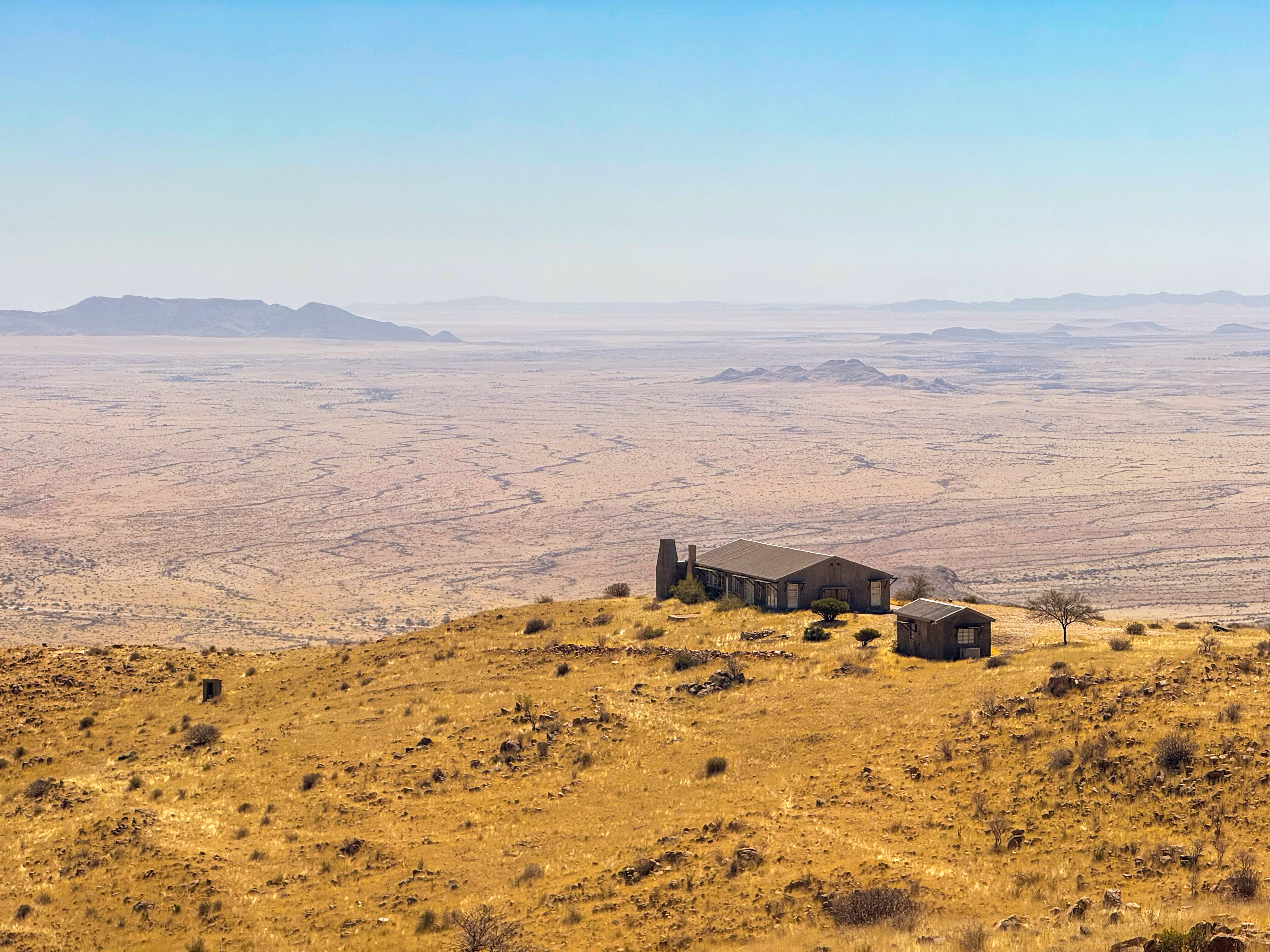
After taking some pictures and videos to immortalize this milestone, I drove us up the slope to the road again, out of the parking lot. Soon after, the gravel road transitioned into a paved road—and for good reason. Over the next 4 kilometers, we would plunge 1000 meters in altitude on a dizzying road that twisted so much it made my palms sweat. It was the only street in Namibia—that I saw—that had guardrails on the side. And I welcomed them. It required all my new-to-driving-on-the-left focus to turn the wheels of our Ranger in the right way and at the right time, while at the same time take in this grotesque view, of an immense valley we so quickly became a part of. It was all just too much. I clutched the steering wheel.
In a matter of minutes, we were down at ground level again and could finally exhale the experience.
“That… was… crazy!” I admitted to Ali. He agreed.
Becoming Spacetime Travellers
We had finally arrived in our daydreams of what we hoped Namibia to be. But we still couldn’t really believe it. Mostly because the scenery that followed the descent didn’t give us any opportunity to process. With the Spreetshoogte Pass in our rearview mirrors, we continued south. But the distance between us and our destination felt gigantic. We were moving through a landscape so enormous and vacant that it felt difficult for our brains to hold. Even our thoughts were thinning out.
“How are we still only this far…?” I repeated to Ali again. “I feel like we’ve driven so much, but we’re still more than 100km away from Sesriem (our end destination for today). It’s like the wheels are just spinning but we’re not going forward.” Ali agreed with me—without making a joke about my driving. I started to feel worried.
“I can’t believe how this landscape keeps changing shapes.” He said. “How is this even real?” He observed while we stared at strange-looking foothills in the distance that resembled what I would imagine Mars looks like.
Here we were, on endless stretches of gravel in an area so big there was no one else to share it with. But instead of feeling as empty as the road, we felt overstimulated to the point of having to stop listening to our audiobook. We didn’t just feel entertained, we felt completely occupied by what was around us. Behind every wide turn hid a new reality: a different shade of sand, another shape of shrubs, a huge rock formation that looked different again from all the others. It was disorientating. Driving through this part of Namibia felt like visiting a new planet every 10 minutes, like an otherworldly experience of motion and space that changed our perception of time.
I’ve always found it difficult to get excited about physics. In fact, I almost had to do a year over in high school because I struggled so much to get interested in this subject’s abstract knowledge. But between Spreetshoogte Pass and Sesriem, in between ever-changing hills on a desolate road, physics stopped being so abstract. I let my eyes glide over Namibia’s strange shapes. I looked at our navigation screen that kept on delaying our estimated arrival time. And while my neurons couldn’t keep up at the time, I understand now, months later, that we experienced spacetime in the flesh. The idea, deeply rooted in physics, that space and time aren’t just separate things that influence each other, but two aspects of the same fabric of our universe. This vast landscape outside my car window was the expansion of time we were experiencing. And we had been swallowed by it. The part that never excited me inside a classroom—that the faster you move through space, the more your time stretches for anyone watching—I had finally felt out there, on the gravel. But there was no one watching except us, being our own distant observers, while the day kept dilating to fit what unfolded all around. The more we tried to speed up the turning of our wheels, the more Namibia would rein us in again. Are we sure that Albert Einstein did not road trip through this country?
I know that we could never have experienced actual relativity at car speed. That only happens at the speed of light. Neither is it possible for the people inside the vehicle to feel their time dilate. The universe reserves that trick for a stranger watching from somewhere else. And there was no stranger that day. There was only us. But our day stretched anyway. Maybe this stretch of Namibia was a portal to other planets, where completely different rules apply.
Next Exit: Planet Earth
Hitting the first intersection after 2,5 hours of driving brought us back to our dimension. Back to what was ahead of us. Our front wheels were surprised to make a full turn to the left and we transitioned from the small gravel road onto a bigger one. We were now as far west as we’d been on this trip and pushing the boundaries of Namib-Naukluft National Park, Namibia’s largest conservation area—and one of the largest national parks in Africa—on the country’s central-western edge. The park covers nearly 50,000 square kilometers and holds the unusual combination of the Namib, the vast desert that runs along the country’s coast, and the Naukluft, a rugged limestone and dolomite mountain massif. From the sound of this, it appeared we were about to enter the next geological masterpiece that would send our minds to outer space.
What was waiting for us in Namib-Naukluft, was an epic dune hike and nightly encounters with strange desert animals, for starters. And for the main course, we were going to experience the park’s key tourist attraction. Located deep in the national park in an area only reachable by 4x4 vehicles hides the Deadvlei, a 900-year-old tree graveyard with a haunting story. It was all going to be a wild ride. But at this moment, on the gravel, we had no idea what Namib-Naukluft was going to do to us.
On the eastern edge of the park lies the entrance point of Sesriem, a small town where our campsite was waiting for us. Getting there should only take us about an hour from where we were right now. But as expected, Namibia stretched our time again. Along this broader road we had gotten on were some real ‘stop-the-car-now-and-take-a-picture’ moments. Left and right we kept on encountering rolling dolomite hills that grew into massive mountains as we neared and eventually passed them. Then we turned one of our last corners and one of those giants faced us dead center. Ali pulled over and we marveled at this sight, like a massive, grey cloud that would never burst.
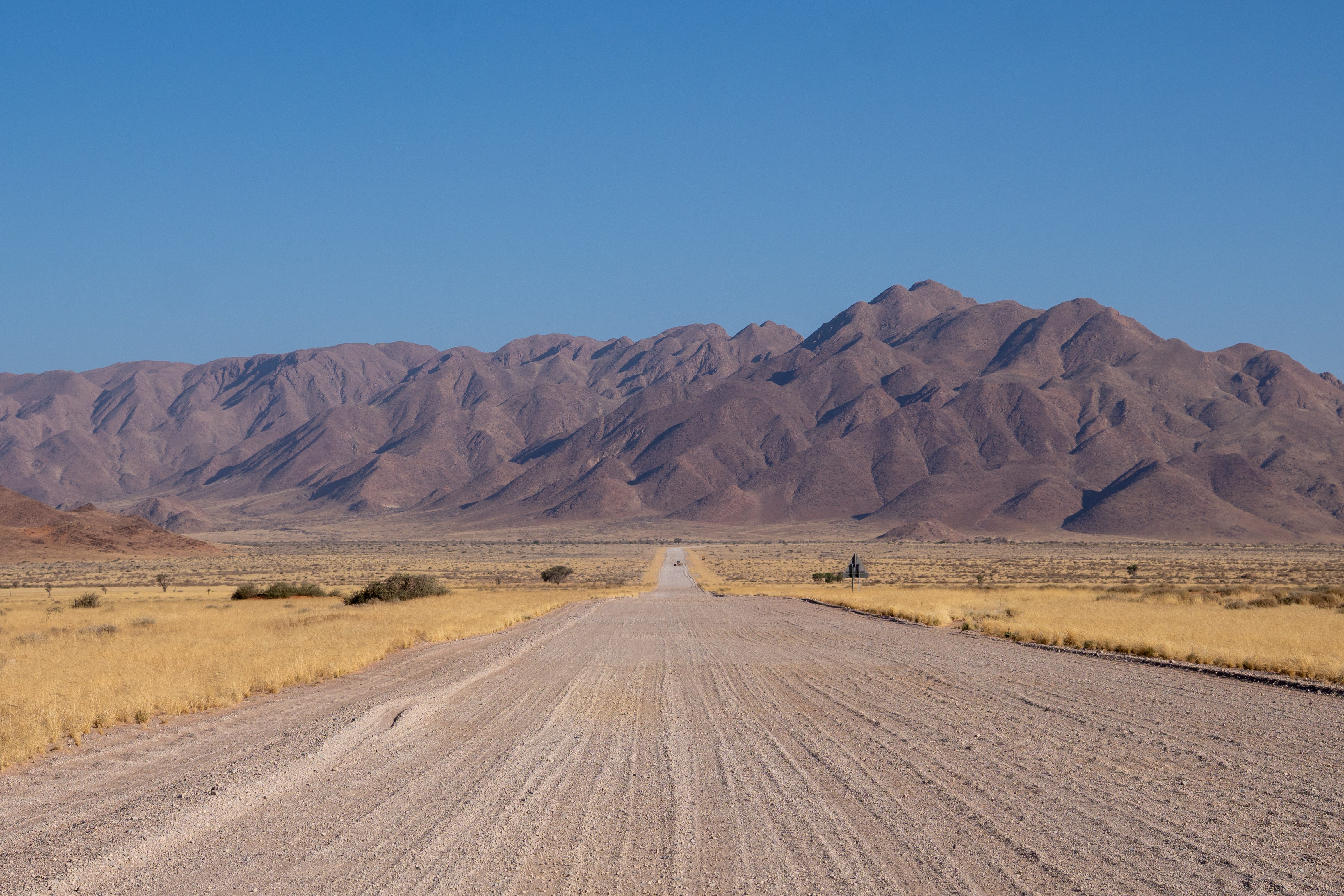
Soon after, we took a right turn onto the road leading to Sesriem and everything was different. We had transitioned from gravel onto asphalt again. And with it, came the transition back into civilization. It felt surreal and smooth, like nothing had happened. But we knew that no matter how smooth the asphalt road would be, we would never forget the wormhole we had driven through today. We saw different lodges and camps on either side of this road. Houses of different shapes, little convenience shops, and… people. There were noises again, other than crickets and the sound of gravel. The clarity of silence and being alone faded, but I welcomed the experience of others. It felt grounding after a day of floating through spacetime. Arriving in Sesriem confirmed we were back on this planet.
Our eyes registered the sign for Sesriem Campsite and we slid into the parking lot. A long exhale followed. Just beyond the nose of our car stood a collection of brownish buildings with cone-shaped straw roofs, looking both cozy and rugged. Like an invitation to hide. Inside, a lady with a warm, welcoming face confirmed our booking and gave us instructions for our two nights of camping here.
“Don’t leave your shoes or any food outside of the car. Because of the hyenas.” She said in a calm voice. I raised my eyebrows at Ali, and he grimaced back.
A man in ranger uniform opened the gate for us and we rolled our Ranger inside. They gave us a pitch on the far left of the campgrounds and as we made our way there, we observed the shapes of this camp. Even though there was a small pool to cool down sweaty guests, Sesriem campsite was mostly practical. A small red toiletry building housed some rows of toilets and showers. And the main straw-roofed reception building we had just been to offered a restaurant, bar and space to eat—or gather for guided safaris. Other than that, it was just a sea of red sand dotted with a handful of pitches, each one marked by a circular, stone wall and a trio of bins outside of them.
We spotted our number, 36, up ahead, sitting right on the edge of the campsite. As we approached, we noticed that beyond it was just a vast plain of deep red sand, only occasionally interrupted by a lonely tree or an orange sand dune. There was no line, no fence. It appeared that nothing would separate us from the surrounding desert and whatever traipsed around in it. No wonder they had a hyena problem.
By now we entered our own stone circle and rolled under the big tree that stood tall in the middle of it.
“I’ll get out and look where our tent will fit.” I told Ali.
“Maybe face this way so we create some more shade with the car?” Ali pointed.
I slammed the door behind me and looked up to locate a clearing in the branches. We took some twists and turns to put our Ford into what we thought would be the best position for living here for the next three days. Soon, we would find out that on this campsite, that would not really matter. After an unexpectedly delayed departure, a rushed sweep through Windhoek, and a full day of spacetime travel, we were ready for a rest day. But would Sesriem give it to us? Towards the west, in the distance, loomed the first big, red sand dune. But it was a baby compared to what you find beyond it. By entering Sesriem we had crossed into the Namib Desert, the oldest desert in the world. In the next days, we were going to experience its ginormous scale—and know what it feels like to walk through it. Letting my eyes glide over this background, I felt so excited to find out the ways in which this place would change us.
Satisfied with our spot, Ali twisted the key. Our beast exhaled. And while she could stop moving, we could not. We were still setting up the rooftop tent and cooking a meal away from settling down. Looking forward to the moment of plunging in my camping chair, I opened the canopy to gather supplies. But once I pressed the handle to lower the tailgate, it did not respond. I called Ali over.
“This thing doesn’t open anymore…?” I gestured. Ali tried the handle too, but the tailgate didn’t move. “Something must have jammed the mechanism, right?” I said, puzzled.
When I took my eyes off the tailgate and into the canopy, I found out what might have caused the jam. Like a souvenir from a day of driving gravel, or a welcome gift from the desert; the camping chairs, the folding table, the fridge, the containers with food and cooking utensils, our backpacks—filled with laptops, cameras and other gear—absolutely everything in our canopy was covered in a thick layer of dust. Our gear looked like we had packed it 40 years ago before a sandstorm apocalypse. We were staggered and not sure what happened. My hands started a search for two packages of Huel. Namibia had already left its mark. Rest was postponed. And once again, we learned that time, in this country, was not ours.
Please let me know what you think of this chapter! Next one coming soon.
As ‘Marola & Ali’ on YouTube, my partner and I make slow travel stories that go beyond the tourist highlights. If you love a good story and coming along on a real adventure, watch our YouTube videos about our journey through Namibia below!
Episode 1:
Episode 2:
Episode 3:
Episode 4:
Episode 5:
Episode 6:
Having all your valuables full of sand is not nice (for anyone wondering)
Namibia would be my most memorable trip! We blew out 2 tires and got stuck in the mud 3 times. Good times! Did you try the Apple Pie in Solitaire?